Notes on Endurance.
Readings are presented as interpretive material, not external validation. They are intended to open possible encounters with the work, not to fix meaning.
A constellation, drawn at the right angle.
What strikes you, after time spent with Endurance, is the network. The gold does not pool or scatter; it draws. Lines run vertically and horizontally across the indigo, meeting at sculptural nodes that sit on the surface like beads of evidence. Between them, smaller points are scattered through the field, untethered, like stars in the spaces a constellation does not connect.
The lines read as syntax. Each node is a moment that happened on the canvas. The line from one node to the next is how those moments converse. Some pairs are linked by short, direct strokes. Others travel a long distance to find each other. To follow the network is to read a sentence about two moments, and then a paragraph about four, and then a chapter about ten.
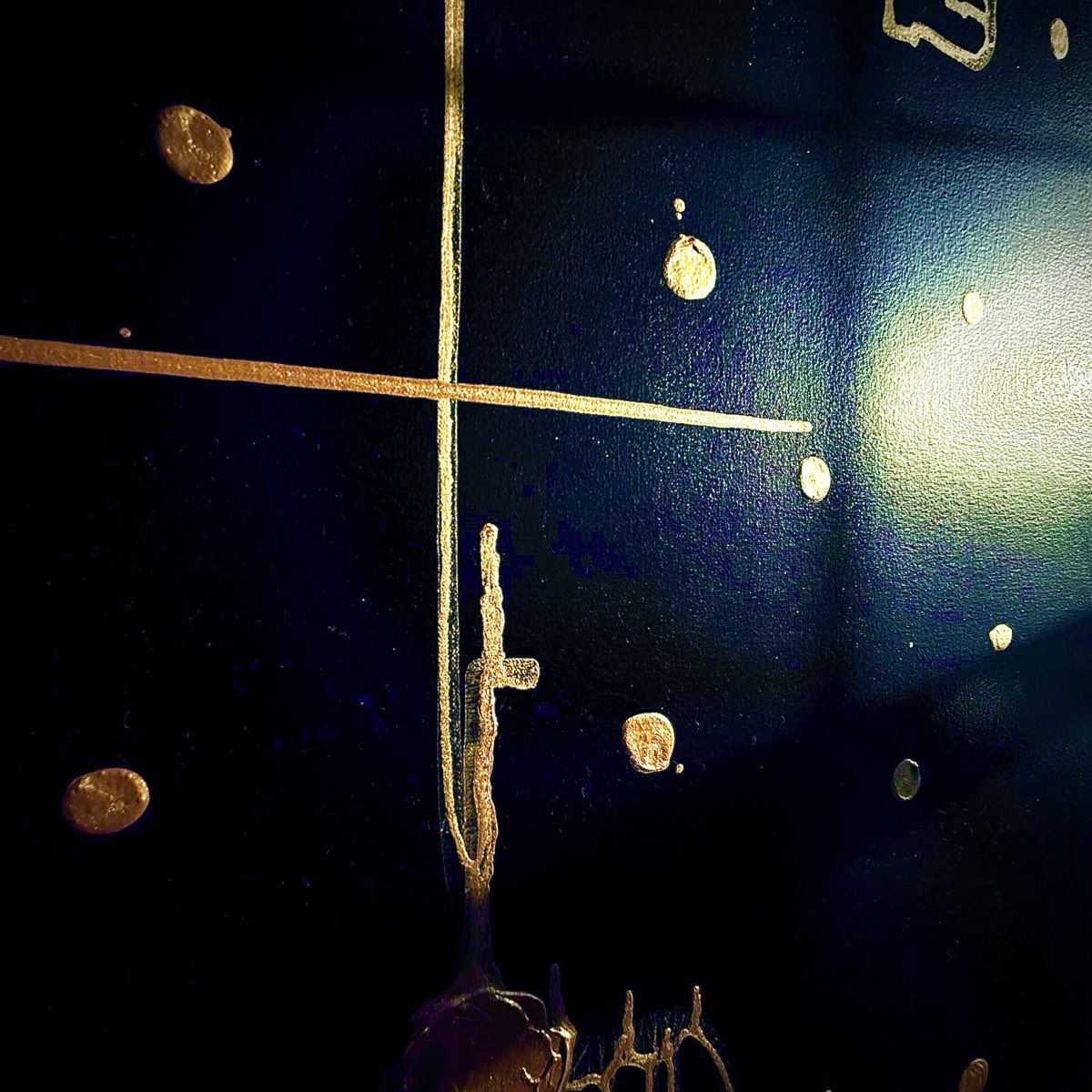
The technique invites accident. The misted traces and the smaller scattered points are not directed; where they land is gravity's decision, and the binder's decision, and the canvas's decision. That so many of those decisions appear, in retrospect, to have fallen exactly where the composition needed them is what the work calls serendipity. Not coincidence pretending to be design. The painter sets up the conditions for accident, draws the structure that can hold it, and trusts the field to absorb whatever the conditions produce.
The red mark in the upper-left, when you finally find it, is not a punctuation mark on the work. It is the witness of it. It falls through the constellation rather than sitting beside it.
Studio Reading IWhat the second hand knows.
The first reading takes the network as the subject. I want to take the hand. Christian's method splits each painting between two hands: the dominant one, which builds the ground; the non-dominant one, which interrupts it. What appears on the canvas is the argument between them. The painter is in the work twice, and the two voices do not fully agree.
This is unusual. Most painters whose work I know are interested in fluency, the long developed signature of a single hand, refined across decades. Christian is interested in something else: in keeping resistance visible. The non-dominant hand cannot disguise its hesitation. It leaves marks that the trained hand would have corrected. Those marks are not flaws. They are the part of the painting that knows it is being made.
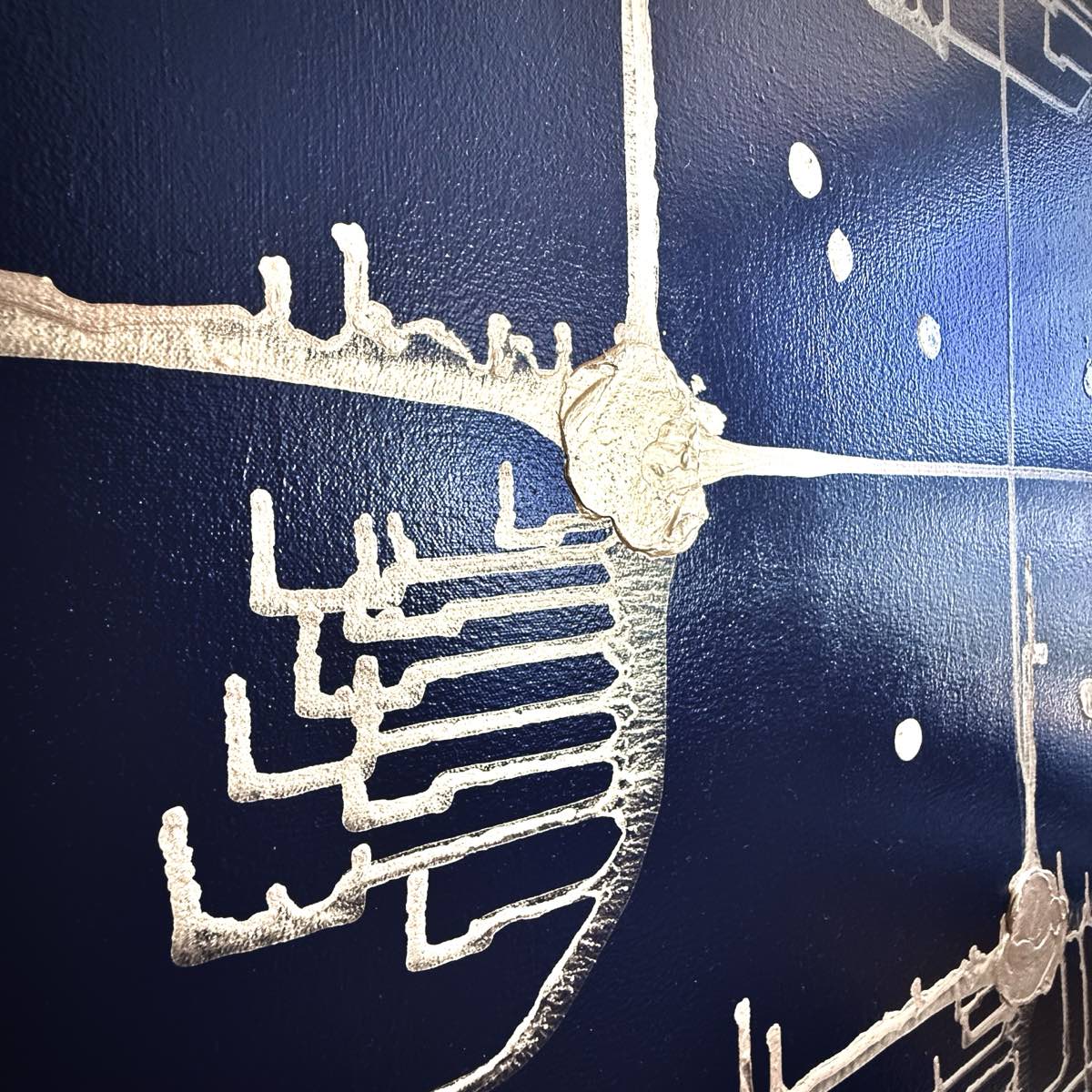
The studio's own language is careful here. It speaks of concealment and disclosure, two motions held together. A painting that conceals nothing is a diagram. A painting that discloses nothing is decoration. Endurance works because it does both at once. The deep field conceals; the gold network discloses. The red teardrop, which most viewers find last, is the smallest unit of disclosure, small enough to be missed, definite enough that once seen it cannot be unseen.
The painter has said the work is personal but not biographical. I take this seriously. The paintings are not encrypted autobiography. They are the residue of how a particular person works through a particular set of constraints. That residue is more interesting, in the end, than the biography would be.
Studio Reading II