Control is present, but never complete.
Each painting in Fields of Consequence is made under a fixed set of conditions. The procedure is consistent across the body of work. The conditions are not decorative. They are the means by which a painting becomes a record of pressure rather than an attempt at accuracy.
Constraint
Each canvas is 72 inches wide and 60 inches tall. Each painting is executed within a fixed temporal constraint set before the first mark. The duration is exact, but the number is secondary to the condition it creates. The limit prohibits correction, prevents over-refinement, and allows unresolved marks to remain as part of the work's structure. The clock is not outside the painting. It is one of the forces acting on the field.
Each work contains irreversible actions that cannot be repaired or overpainted into submission: misting events, dropped paint, ruptures, drags, blooms, and other material events. The painting must absorb them and continue from there.
Ground and Interruption
Each painting begins with a saturated field laid by the dominant hand. The initial ground establishes control, fluency, and order. It is not a backdrop. It is the painting's atmospheric condition.
Later interventions are made with the non-dominant hand. Resistance and instability enter the surface. The hand that hesitates leaves a different mark than the hand that knows. The non-dominant hand cannot disguise its hesitation; the marks it leaves are not flaws but the part of the painting that knows it is being made.
Water and Metallic Paint
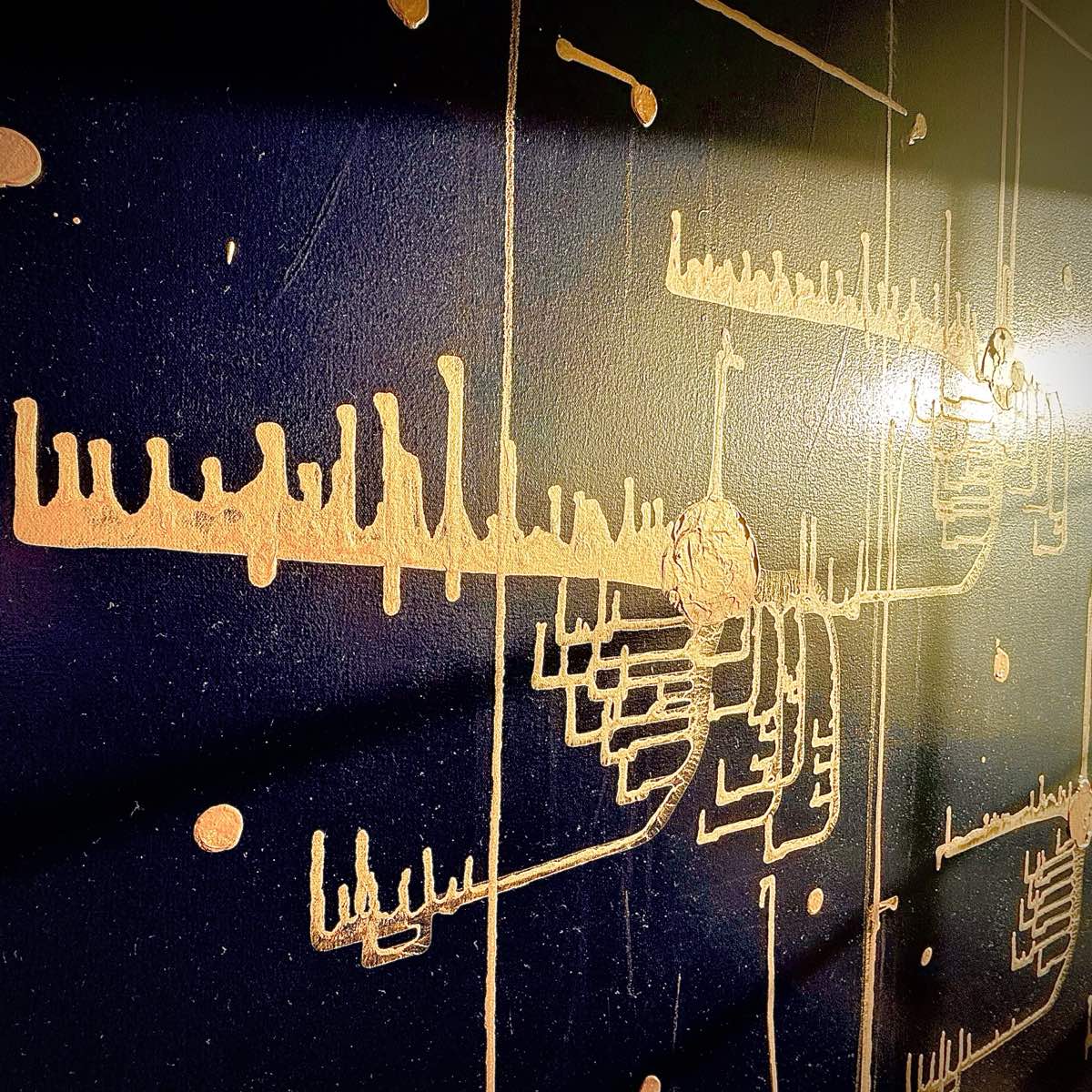
While the metallic paint is still wet and heavily loaded, a fine targeted mist of water is sprayed onto selected gold passages. The water breaks the surface tension. It pools at the lower edge of the palette-knife marks and slowly loosens the binder until small beads of diluted metallic pigment begin to breach the mass. Rather than brushing or directing the lines, gravity and fluid dynamics determine their movement.
The amount of water misted onto each metallic mass varies. The angle of the canvas during misting determines which way the released pigment travels. Combined with rotation between activations, this is what produces the multiple gravity signatures present on a finished surface.
Metallic Register
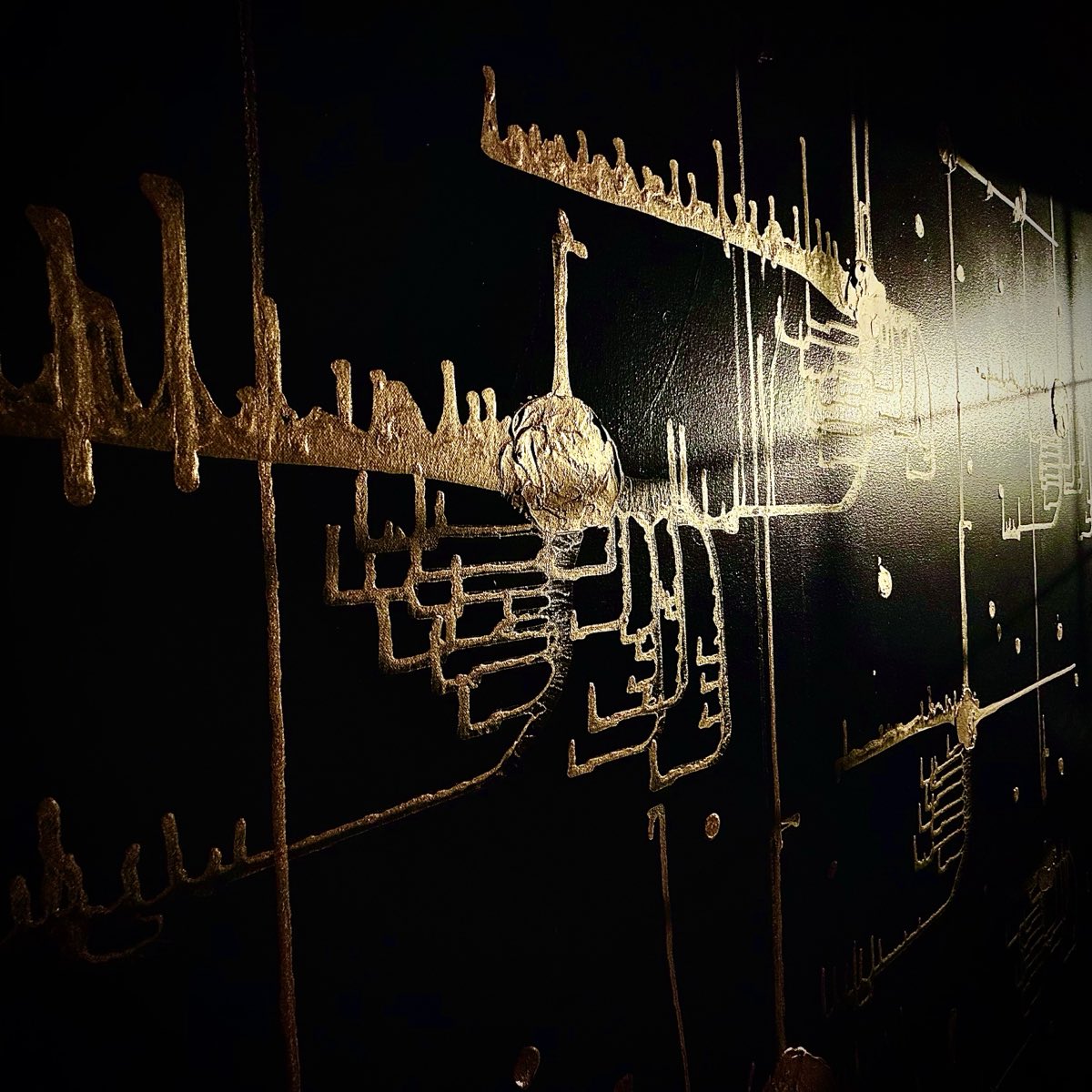
Each chapter's metallic register is chosen to serve the chapter's condition, not to maintain uniformity across the body. Three metals appear across the six paintings. Each is loaded as heavy impasto, water-misted, and rotated under the same procedure. The metal varies; the conditions do not.
Gold appears where the marks hold or reveal. It is the metal of permanence. It does not tarnish. It survives. Gold is present in Endurance, where the network holds the field, and in Immanence, where the divine is recognized in the matter of the field itself.
Silver appears where the marks listen or release. It is the metal of mirrors and of beam-light, of reception rather than assertion. Silver is present in Attunement, where the painting is a posture of careful listening, and in Ablution, where the painting documents what survives ritual cleansing.
Bronze appears where the marks deal with fire or metal directly. It is the metal of bells, of weapons, of cast objects. It carries warmth into warm fields and reads as combustion absorbing combustion. Bronze is present in Rupture, where the marks are consumed by the field, and in Reclamation, where the marks document the casting of fresh form from oxidized ground.
The water-misted procedure is calibrated to behave consistently across all three metals. The traces, the gravity signatures, and the surface ruptures read as the same procedure regardless of which metal is loaded. The metal varies; the conditions do not.
Gravity and Rotation
After the deep ground has cured and the heavy metallic impasto passages are applied, the canvas is set vertically or on a slight incline. The canvas is then rotated clockwise between selected activations. Each new activation acts from a different orientation. The finished surface may carry multiple gravity signatures: traces that descend, drift, angle, or contradict. Some lines fall straight. Others move diagonally. Some merge, pool, fade, or stop abruptly.
The procedure carries built-in variables. The force applied during each rotation varies. The angle of rotation is not fixed and may change between events. The canvas may be rotated additional times in unspecified directions. These variables are the reason the same procedure produces a different painting every time it is run.
Dropped Paint
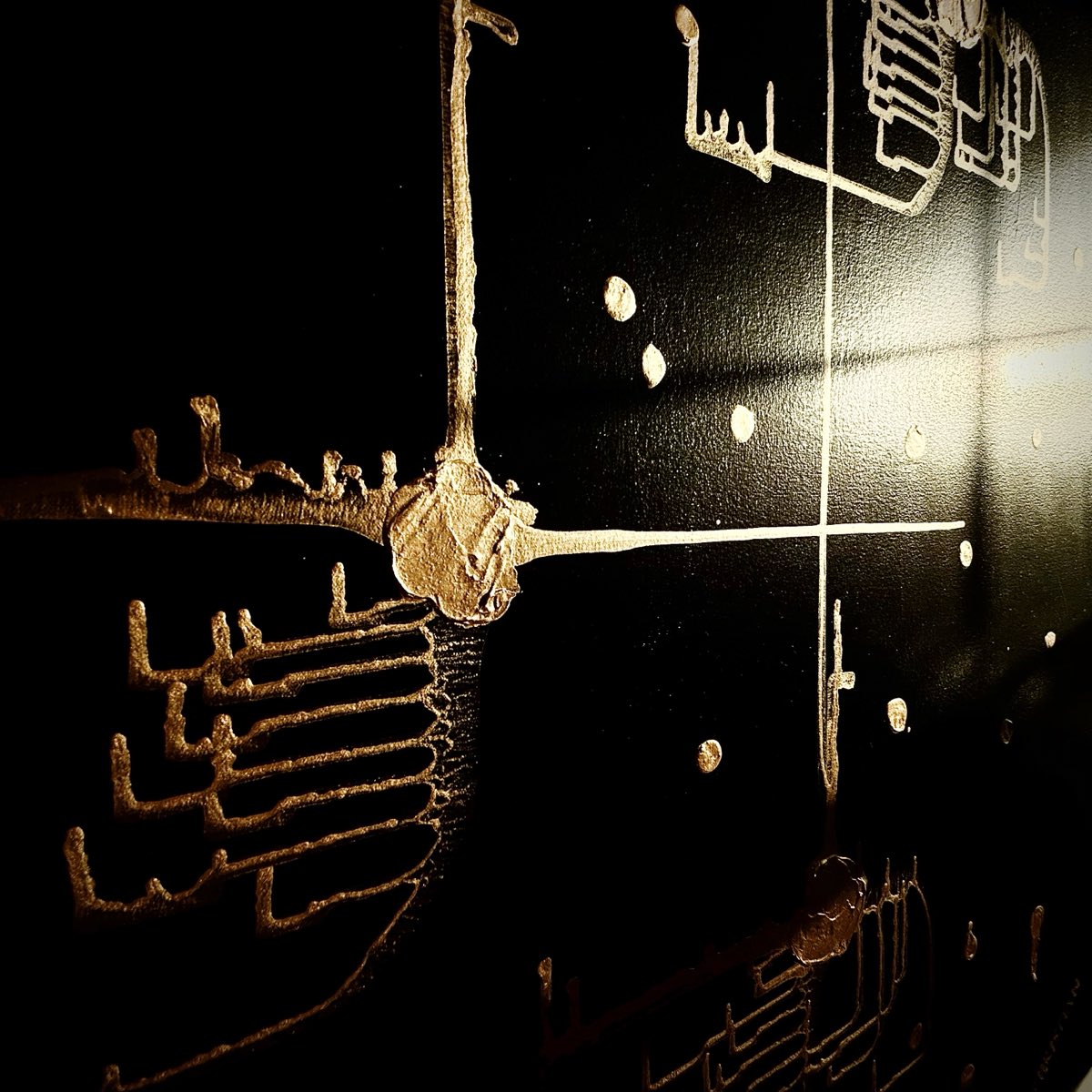
Painting is also made by direct gravitational deposit. Drops of paint are released onto the surface from approximately three feet above the canvas. Velocity, air resistance, and impact determine the resulting mark; the artist determines only the point of release.
Inversion
Each painting is shown hung in the orientation opposite to the one in which it was made. The procedure builds the canvas with gravity descending toward what becomes the top of the displayed work; the viewer encounters the surface inverted from its making. The marks read as ascending rather than descending. The wall denies the gravity that authored the surface.
Consequence
Each work is bound to a fixed temporal constraint that prohibits correction. What appears unresolved or imperfect is structural, not incidental. The paintings are not attempts at accuracy, but records of decisions made under pressure, where consequence replaces refinement.